What defines an ai narrative coin
The term "AI crypto" is often used loosely, but not every project using machine learning qualifies as a narrative coin. Most established blockchain companies use AI for internal efficiency—optimizing node performance, detecting fraud, or managing treasury assets. These are operational upgrades, not market narratives.
An AI-generated narrative coin is defined by a specific structural dependency: the token’s value proposition or core utility relies on generative AI outputs or autonomous agent behavior. The AI isn’t just a backend tool; it is the primary driver of user engagement or asset scarcity. For example, a project might issue tokens that are consumed by AI agents to access creative generation services, or the token might govern a decentralized network of autonomous agents executing trades or content creation.
This distinction matters because it separates infrastructure plays from speculative narrative trades. Projects like Render or Bittensor provide the computational substrate for AI, which is a different category than coins where the AI is the product. When evaluating an ai narrative coin, look for clear evidence that the tokenomics are designed around the consumption or governance of AI-generated content or actions, rather than just the storage or computation of data.
Note: This guide focuses on coins where AI is central to the token's utility or market narrative, not just projects using AI for internal operations.
Understanding this boundary helps filter out the noise. The market often conflates "AI-enabled" with "AI-native." By focusing on narrative coins—those where generative AI creates the economic loop—you can better assess whether a project has genuine utility or is simply riding a trend.
The Infrastructure Behind AI-Generated Narrative Coins
AI-generated narrative coins do not exist in a vacuum. They rely on a specialized stack that separates them from traditional AI projects. Understanding these layers—compute, data, and model markets—reveals why certain tokens command high valuations while others fade. The value driver here is not just the AI model itself, but the decentralized infrastructure required to run it efficiently and transparently.
Compute: Decentralized GPU Networks
Training and inference for large language models require massive graphical processing power. Centralized cloud providers dominate this space, but AI-generated narrative coins leverage decentralized GPU networks to lower costs and increase redundancy. Projects like Render and Akash Network allow users to rent unused GPU power from a global pool. This infrastructure is critical for AI agents that need to process data in real-time without relying on a single corporate server.
Data: Verifiable and Tokenized Information
AI models are only as good as their training data. In the crypto space, data infrastructure focuses on verifiability and privacy. Projects like Skynet Network (SkyAI) and Ocean Protocol provide decentralized data marketplaces where AI agents can access high-quality datasets. These platforms often use zero-knowledge proofs or homomorphic encryption to ensure that sensitive data remains private while still being usable for model training. This solves a major bottleneck in AI development: the scarcity of clean, verified data.
Model Markets: Incentivizing Intelligence
The final layer is the marketplace for the models themselves. Platforms like Bittensor (TAO) operate as a decentralized subnet economy where miners compete to provide the best AI outputs. Users pay in the native token to access these models, and miners are rewarded based on the quality of their contribution. This creates a self-correcting market where the most useful AI models rise to the top, driving innovation and utility for the entire ecosystem.

Infrastructure Comparison
| Layer | Primary Function | Key Example Projects |
|---|---|---|
| Compute | Decentralized GPU rental for inference | Render, Akash Network |
| Data | Private, verifiable data marketplaces | Ocean Protocol, SkyAI |
| Model Markets | Incentivized AI output competition | Bittensor (TAO) |
This tripartite structure ensures that AI-generated narrative coins are not just speculative tokens, but functional components of a larger, decentralized technological ecosystem.
Top ai crypto coins to watch in 2026
The AI crypto sector is shifting from speculative hype to tangible infrastructure. In 2026, the most resilient assets are those solving specific bottlenecks: decentralized compute, autonomous agent coordination, and verifiable data. We are tracking tokens that function as the rails for this new digital economy.
These AI-Generated Narrative Coins are categorized by their primary utility. Understanding the role each token plays helps you assess risk and potential upside more accurately than looking at market cap alone.
Bittensor (TAO): The Decentralized Marketplace
Bittensor is the leading decentralized AI marketplace. It operates as a subnet economy where miners contribute machine learning models to a shared network, earning TAO in return. This structure creates a competitive environment for AI development without relying on a single corporate entity.
TAO’s value is tied to the quality and utility of the models it hosts. As demand for decentralized inference grows, the network’s ability to scale while maintaining security becomes its primary growth driver.
Render (RENDER): GPU Infrastructure
Render provides decentralized GPU rendering and compute power. As AI models require massive parallel processing, Render’s network connects users needing compute with idle GPU owners. This effectively turns underutilized hardware into a valuable resource for AI training and rendering workloads.
The token serves as the settlement layer for these transactions. Its performance is closely linked to the broader demand for graphics processing, which is now heavily influenced by AI generation tasks.
Fetch.ai (FET): Autonomous Agents
Fetch.ai focuses on building autonomous AI agents that can perform tasks on behalf of users. These agents can negotiate, transact, and execute complex workflows across different blockchains. This moves AI from a passive tool to an active participant in the digital economy.
The convergence of AI agents with DeFi creates new use cases for automated trading, travel booking, and data sharing. FET’s ecosystem is designed to facilitate these interactions securely.
NEAR Protocol: Scalable Data Layer
NEAR Protocol is expanding its infrastructure to support AI workloads. Its sharded architecture allows for high throughput and low costs, making it suitable for data-heavy AI applications. NEAR is positioning itself as the data availability layer for AI agents.
Projects building on NEAR are leveraging its speed to create real-time AI interactions. This makes NEAR a critical piece of the puzzle for AI applications that require instant data retrieval and processing.
SingularityNET (AGIX): AI Service Marketplace
SingularityNET is a decentralized marketplace for AI services. Developers can publish their AI algorithms, and users can access them via the AGIX token. This lowers the barrier to entry for AI development and creates a liquid market for specialized AI models.
The platform emphasizes open access and collaboration. By removing intermediaries, SingularityNET aims to accelerate the development and deployment of useful AI tools.
The Graph (GRT): Indexing AI Data
The Graph provides indexing infrastructure for querying data from blockchains and other sources. For AI applications, having structured, queryable data is essential. The Graph allows AI agents to access real-time blockchain data efficiently.
As more AI projects rely on on-chain data for decision-making, The Graph’s role as the "Google of blockchain" becomes increasingly vital. GRT ensures that this data is accessible and reliable.
Akash Network: Decentralized Cloud Compute
Akash Network offers a decentralized cloud computing marketplace. It allows users to rent computing power from providers around the world, often at a fraction of the cost of centralized cloud providers. This is particularly useful for AI training tasks that require significant compute resources.
Akash’s open-source approach and competitive pricing make it an attractive option for AI startups and researchers looking to optimize their infrastructure costs.
Tracking AI Market Sentiment
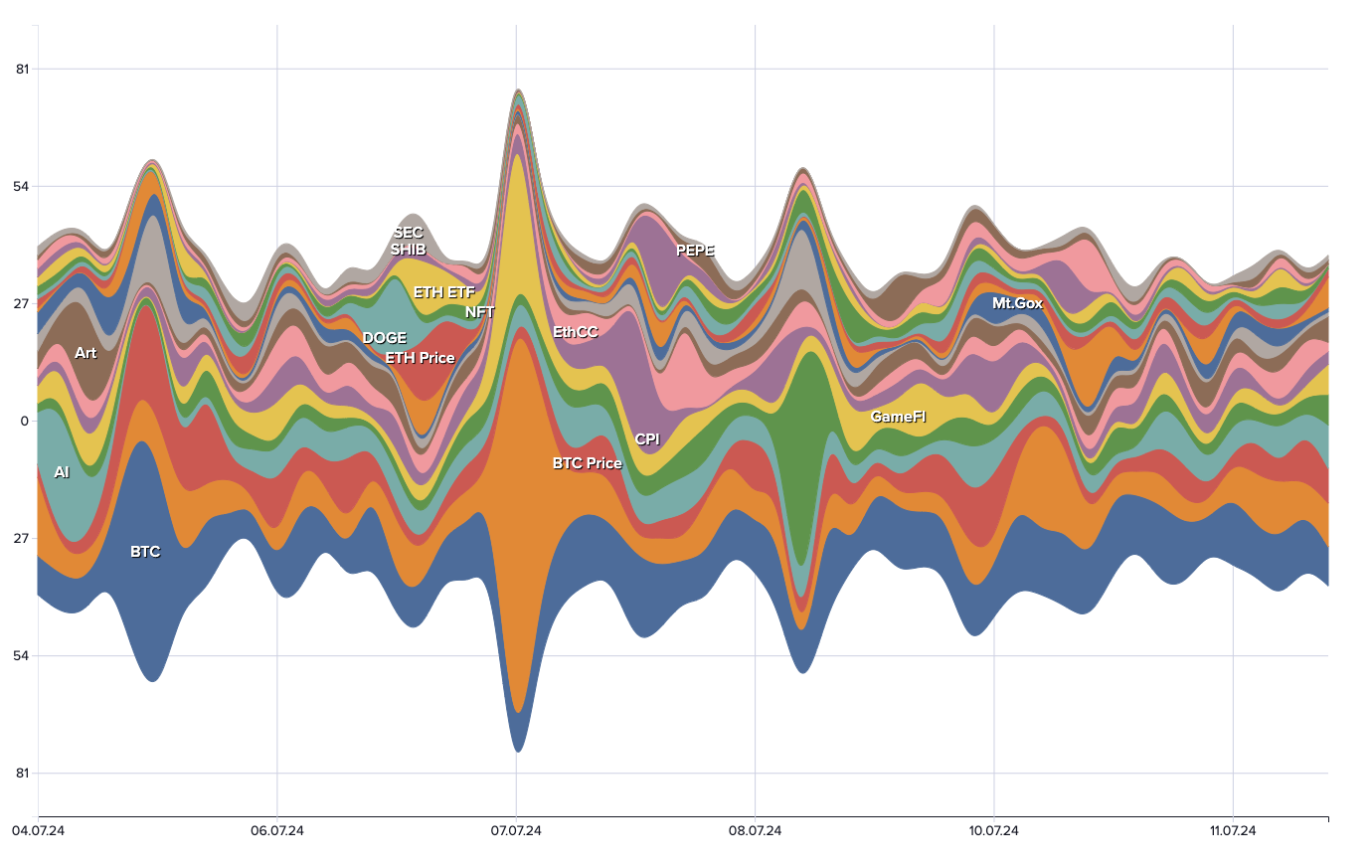
Price charts tell you where an AI-generated narrative coin has been, but they rarely tell you where it is going. To stay ahead of the curve, traders need tools that measure the health of the narrative itself. This means looking at developer activity, social volume, and on-chain momentum rather than just daily candlesticks.
On-Chain and Developer Metrics
The most reliable indicator of long-term health in the AI crypto space is developer activity. Projects like Bittensor (TAO) and Render (RENDER) show strength not just through price, but through the number of active contributors and subnet deployments. Tools like GitCoin and GitHub analytics provide a clear view of whether a project is building or just marketing. If code commits drop while the price rises, it is often a sign of a hollow narrative.
Social Volume and Sentiment
Social sentiment acts as the early warning system for narrative shifts. Platforms like LunarCrush and Santiment track mentions, engagement rates, and sentiment scores across Twitter, Reddit, and Discord. A spike in positive sentiment often precedes price action, especially for smaller AI tokens. However, be wary of artificial inflation; bots can skew these metrics. Cross-reference social spikes with actual trading volume to confirm genuine interest.
Visualizing the Trend
Seeing the data plotted against price helps identify divergences. When social sentiment remains high but price stagnates, it may indicate accumulation. Conversely, a price surge with falling sentiment often signals a top.
Essential Tools for Monitoring
To effectively track AI-generated narrative coins, you need a stack of tools that cover different angles of the market. Here are the essential resources for monitoring sentiment and infrastructure.



As an Amazon Associate, we may earn from qualifying purchases.
Due Diligence and Risk
The AI narrative in crypto moves fast, often outpacing the underlying technology. For investors in AI-generated narrative coins, hype can mask a lack of substance. A token might claim to use artificial intelligence for trading or data analysis, but without verifiable infrastructure, it remains a speculative gamble. This section outlines the due diligence steps necessary to separate functional projects from marketing-driven traps.
Don't rely on whitepapers alone. Check if the AI model actually runs on-chain or interacts with decentralized oracle networks. Look for smart contract audits from reputable firms like Halborn or OpenZeppelin. If the "AI" is just a buzzword in the marketing deck with no code to back it up, treat it as a high-risk asset.

AI projects often have complex token distributions. Examine the vesting schedules for team and investor tokens. A large unlock of tokens in the near term can lead to significant sell pressure, crashing the price regardless of technological progress. Ensure the utility token has a clear mechanism for burning or staking that benefits holders.
Anonymous teams are common in crypto but risky in AI, where technical expertise is paramount. Look for doxxed founders with verifiable backgrounds in machine learning or blockchain development. Check their GitHub activity and previous project outcomes. A lack of public identity often correlates with a lack of long-term accountability.
TechnicalChart symbol="NASDAQ:COIN" chartStyle="line" interval="1D" indicators='["volume"]' />
The infrastructure supporting AI coins is still maturing. While projects like Render Network and Bittensor have established real-world usage, many newer entrants are still proving their viability. Use the TechnicalChart above to monitor broader market sentiment, which often influences AI token performance. Always prioritize projects with active development and clear revenue models over those with only ambitious roadmaps.
Frequently asked questions about AI coins
What distinguishes an AI narrative coin from a standard AI project?
Standard AI projects use machine learning for internal efficiency, such as fraud detection or treasury management. An AI narrative coin has a token whose value or utility is directly tied to generative AI outputs or autonomous agent behavior. The AI is the product, not just a backend tool.
How does Bittensor (TAO) create value for its token holders?
Bittensor operates as a decentralized subnet economy where miners contribute machine learning models. Users pay in TAO to access these models, and miners are rewarded based on output quality. This creates a competitive market where the most useful AI models rise to the top, driving demand for the TAO token.
Why is decentralized compute important for AI crypto projects?
Centralized cloud providers dominate GPU access, often creating bottlenecks and high costs. Decentralized networks like Render and Akash allow AI agents to rent GPU power globally, lowering costs and increasing redundancy. This infrastructure is critical for scaling AI workloads without relying on single corporate servers.
What are the risks of investing in AI-generated narrative coins?
The primary risk is hype outpacing technology. Many projects lack verifiable infrastructure or clear tokenomics. Investors should verify on-chain utility, assess token vesting schedules for potential sell pressure, and evaluate team transparency. Projects with anonymous teams or no code commits are particularly high-risk.
No comments yet. Be the first to share your thoughts!